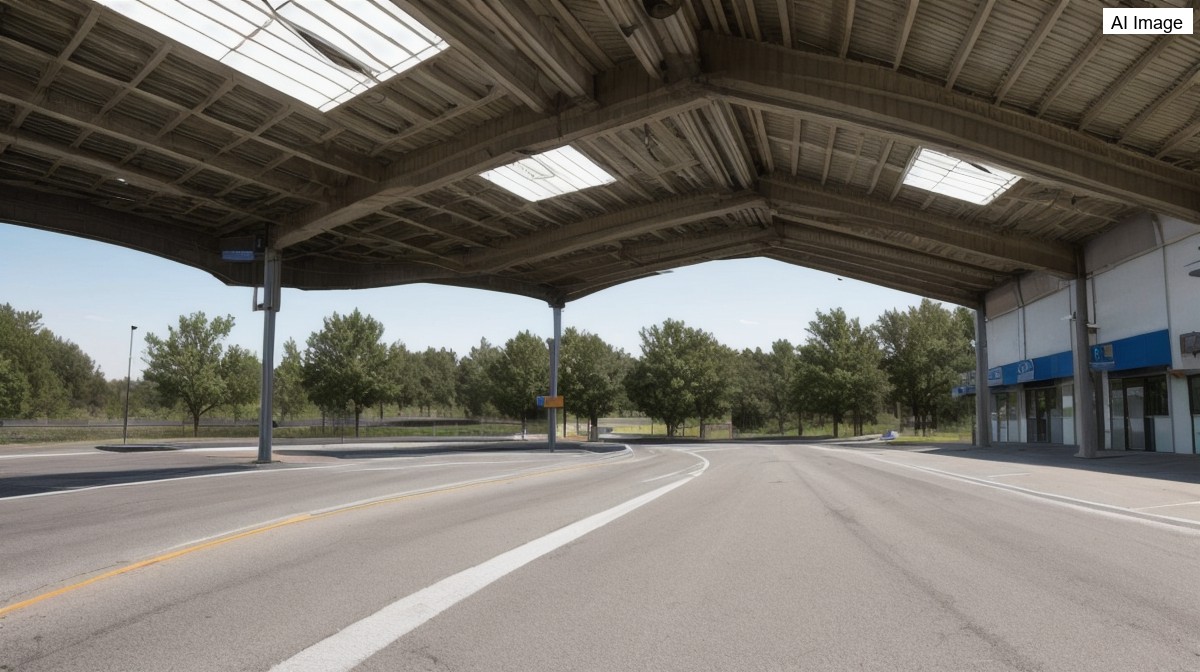
The new United States port of entry at the Gordie Howe International Bridge opened its doors to reporters this week, offering a look at one of the busiest points in the trade relationship between Canada and the US. The facility was paid for entirely by Canada as part of the bridge's 6.4 billion dollar construction cost, and at 400,000 square feet sitting on nearly 170 acres of land, it was described as the largest northern border port for trade and travel. US Customs and Border Protection invited the CBC and a handful of other news outlets to tour it.
The visit came against a tense political backdrop. Last year, US President Donald Trump declared national emergencies at both the southern and northern borders, using the fentanyl crisis as justification for tariffs. When he first imposed tariffs on Canada, he cited the country's inability to prevent drugs and human traffickers from pouring across the border into the US, framing it as a national emergency that demanded a response.
But officials on the ground in Michigan described a picture that is a lot more complicated than that. One said it was really not that big of a problem for inbound traffic, and that a lot of what they actually get is going outbound, from the US into Canada. Asked whether the same was true of guns, the answer was that firearms are mainly coming from the US side and heading north into Canada.
Part of what turns up at the crossing comes down to simple mistakes. Officials said a lot of people make wrong turns, ending up on the bridge or in the tunnel by accident, and the subsequent vehicle searches sometimes result in the finding of weapons. Beyond those accidental crossings, there is also a more robust illegal trade: in 2024, nearly 90 percent of guns recovered in crimes in Ontario were traced back to the United States.
A border expert featured in the report said both countries pose threats to each other, but in different ways. Firearms move one way, while the United States sits in the middle ground for drugs coming up from Mexico and South America. Going south, the expert said, the threat that Canada poses is really the people it lets in on temporary status, a framing that cuts against the idea of a one-directional crisis at the northern line.
Despite the political tensions, US officials said the working relationship with their Canadian counterparts remains unchanged. They pointed to strong local partnerships with agencies right across the water, saying those ties continue regardless of the friction between the two governments. For now, they said, those partnerships continue to bridge the political divide, with security on both sides of the border depending on the cooperation holding.
The figures cited in the report underscored the direction of the flow. In 2025, US border officials in the Detroit sector seized more than 9,300 pounds of illegal drugs, including 33 pounds of fentanyl, according to Customs and Border Protection, though the statistics do not reveal which way the drugs were traveling. Figures cited in the report put fentanyl seized at the US southern border at almost 71,000 pounds from 2022 to 2025, compared with only 134 pounds at the northern border.