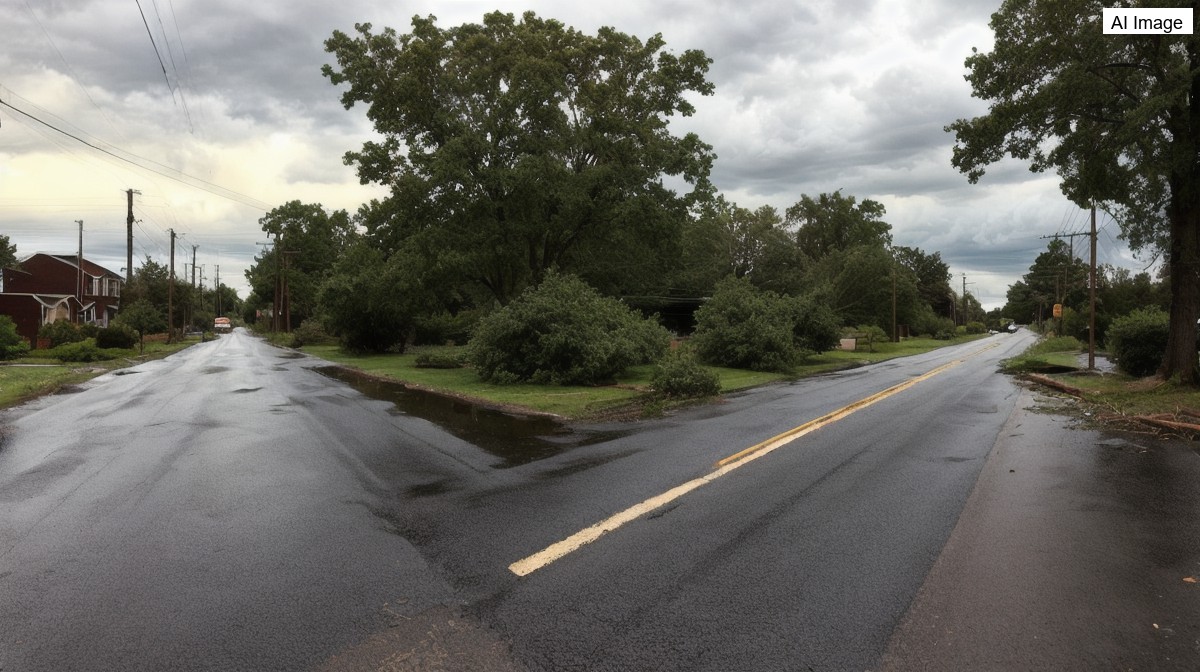
A violent line of thunderstorms roared across New Jersey and pushed into New York City on Friday evening, carving a path of destruction across the region just as it prepared to mark the Fourth of July holiday. The fast-moving system swept through in a matter of minutes but hit with ferocious force, toppling trees, tearing down power lines and leaving communities to grapple with the aftermath in the sweltering heat. Officials described the storms as some of the most damaging to strike central New Jersey in recent memory, and the scale of the wreckage became clear even before the skies had fully cleared.
The hardest-hit area was in and around Plainfield, in central New Jersey, where the damage was severe enough that the city declared a state of emergency. Local officials said more than 80 trees had come down across the community, many of them tangled in power lines or blocking roadways, while numerous homes were damaged and multiple vehicles were crushed. In response, the mayor moved to cancel all of Plainfield's Fourth of July festivities, including its planned parade, concert and fireworks display, so that crews could focus on cleanup and public safety heading into the holiday weekend.
Neighboring North Plainfield was also placed under a state of emergency as the extent of the destruction became apparent. Across the two communities, emergency crews and public works teams faced a daunting recovery effort, with blocked streets, downed wires and damaged property scattered throughout residential neighborhoods. Officials urged residents to stay clear of fallen trees and power lines, warning that hazards remained even after the storms had passed and that the cleanup would stretch on well into the holiday.
Meteorologists said the storms drew their energy from the extreme heat that had gripped the region for days, with temperatures soaring into the triple digits and providing ample fuel for a fierce squall line. Forecasters clocked wind gusts of roughly 70 miles per hour or more in several locations, including an official gust of 71 miles per hour at Newark Airport after the city had hit 102 degrees earlier in the day. Gusts of about 70 miles per hour were recorded in Perth Amboy and 67 miles per hour near Bradley Beach along the Jersey Shore, illustrating how widely the destructive winds were felt.
The damage extended well beyond the Plainfield area. In Jersey City, emergency crews responded after part of a building that appeared to be under construction partially collapsed in the high winds, though no injuries were reported there. Reports of downed trees poured in from towns including Bayonne, Rutherford and Clark, and the powerful gusts were strong enough to flip an 18-wheeler onto its side on the Verrazzano-Narrows Bridge in New York City. Across the Garden State, emergency dispatchers fielded a steady stream of calls as trees fell onto homes, wires and streets.
Transit networks were also thrown into disarray as the storms passed. Service was disrupted after debris was found across multiple tracks near Hoboken Terminal, and a tree came down on overhead wires near Broad Street in Red Bank, snarling rail travel at the start of a busy holiday weekend. Combined with the widespread power outages, the transit troubles compounded the misery for residents already contending with dangerous heat, as utility crews and emergency workers scrambled to restore service and clear blocked roadways.
As the region turned toward the Fourth of July, forecasters warned that the oppressive heat was not yet finished, with an extreme heat warning set to continue through the holiday before temperatures were expected to ease. For communities like Plainfield and North Plainfield, however, the immediate focus shifted from celebration to recovery. Officials urged residents to stay cautious around downed lines and damaged trees as cleanup got underway, and the cancellation of holiday events stood as a somber marker of a storm that turned a night of anticipated festivity into one of widespread damage and disruption.