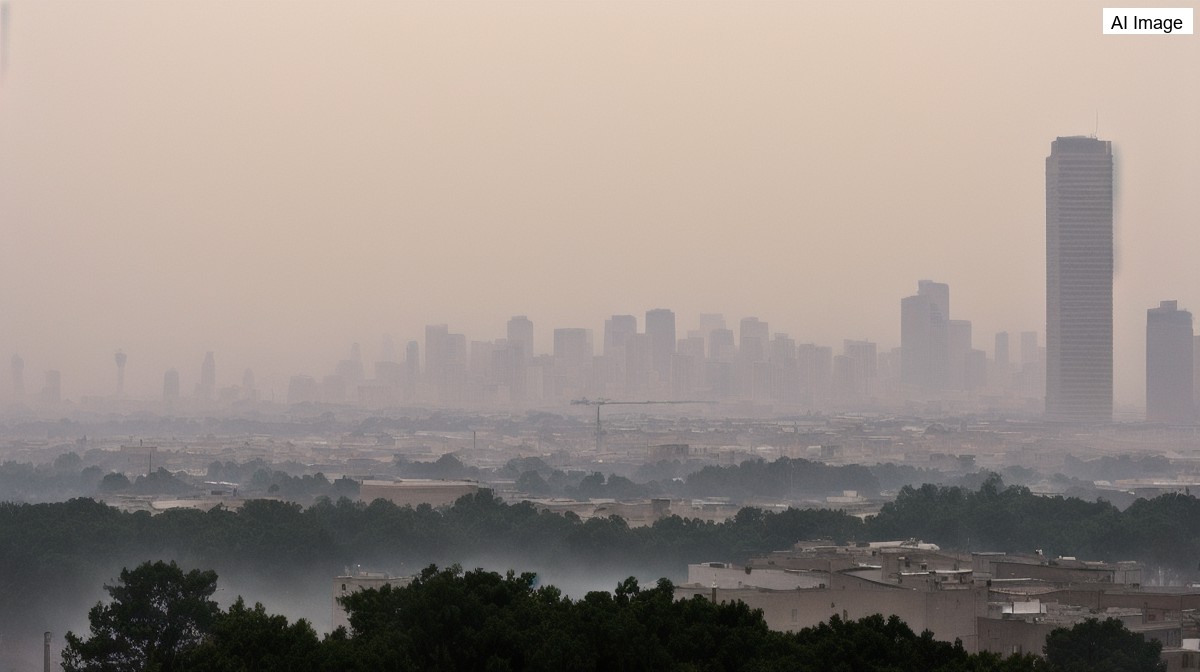
A thick plume of smoke drifting down from wildfires burning across Canada has pushed air quality throughout the northeastern and Great Lakes portions of the United States into unhealthy and, in some places, hazardous territory. Forecasters said the smoke was moving toward the region and bringing with it extremely poor air, along with the potential for the eerie orange skies that many in the Northeast remember from previous smoke events.
By the third day of the event, the smoke had spread well beyond the Northeast. Officials said roughly 115 million Americans across 19 states, from Minnesota to Massachusetts and through the Great Lakes, were under air quality alerts, with some of the country's biggest cities, including Chicago, Detroit and New York, shrouded in a thick orange haze that dimmed skylines and blotted out the sun. Milwaukee reported its worst air quality on record, and in Toledo, Ohio a reading topped 800, far above the threshold of 300 that is considered hazardous. At one point Detroit and Chicago had the worst air quality of any major cities in the world, according to IQAir, with smoke from hundreds of wildfires burning across Canada drifting more than a thousand miles. In Philadelphia, a Mets Phillies baseball game was moved up an hour and the Federal Aviation Administration slowed arrivals into the city's airport, with pilots reporting ash sticking to their windshields.
The smoke rippled into daily life and sport as conditions worsened. Health systems reported a jump in cases tied to the air, with the Cleveland Clinic saying it had seen a 10 percent spike in emergency room patients because of the poor air quality. Philadelphia declared a code purple for very unhealthy air, and in New York City the National Guard was brought in to help hand out masks. Major League Baseball was disrupted too, as the Cleveland Guardians postponed their game against the Pittsburgh Pirates over air quality concerns and the Milwaukee Brewers allowed fans to exchange their tickets, on top of the earlier decision to move up the Phillies Mets game in Philadelphia.
Detroit mounted one of the most sweeping municipal responses. City officials called it one of the most significant air quality events Detroit had experienced in years, saying the index had reached hazardous levels above 300 and that readings in parts of the city and southern Michigan had climbed past 600, 700 and even 800. The city opened all of its recreation centers as respite locations, handed out masks there and through street outreach teams, canceled all outdoor city events including its Occupy the Summer programming, directed non-essential municipal employees to work from home and sent a wireless emergency alert to every phone in the area. Officials said crews were carrying out wellness checks at 110 senior buildings and on other vulnerable residents, and the city's chief medical executive reported that of a fairly typical total of around 350 emergency medical responses the previous day, some 80 had been for respiratory complaints, against 40 to 50 on an ordinary day. He tied that to the roughly 20 percent rise in emergency room visits often seen during wildfire smoke, warned that the fine PM2.5 particles settle deep in the lungs, and described the readings as unprecedented and the worst since a comparable bout of Canadian smoke in 2023, cautioning it could become a new norm.
In New York City, the situation was among the most closely watched. Officials reported that the air quality index stood at 177, a level classed as unhealthy, and said the forecast called for the reading to remain in that category for a period. Anyone in the affected area, they cautioned, would be well advised to check in with local health monitors and pay attention to the latest advisories as conditions shifted through the day.
Drawing on National Weather Service data, forecasters said the air had reached a level red in parts of New York City. According to the AirNow index, a level red corresponds to a reading between 151 and 200, which is considered unhealthy, and the guidance that came with it was blunt: New Yorkers were told to avoid any strenuous activity while outdoors and to remain indoors if they could. Later in the day, the index was expected to climb toward 200.
In response to the deteriorating air, Governor Kathy Hochul announced that the state would give out 100,000 high-quality N95-style masks. The masks were to be handed out through the Metropolitan Transportation Authority and distributed at busy commuter areas such as Penn Station and Grand Central, so that the many people passing through the transit system, where the air can feel especially heavy, would have some protection as they moved around the city.
The smoke arrived alongside a spell of dangerous heat, creating what one reporter described as a deadly cocktail. Temperatures had reached around 100 degrees the previous day, with heat advisories in force, and the combination of high heat and thick, unhealthy air made even short walks outside uncomfortable. People spoke of a burning feeling in their lungs and of a strained, heavy quality to the air as they moved about the streets and the subway.
New York City Mayor Zoran Mamdani warned residents about the compounded risk. He said the combination of dangerous heat and unhealthy air was a serious threat to New Yorkers' health, advising people to stay somewhere cool with air conditioning, limit their time outdoors, drink plenty of water and check on their neighbors. He said city agencies were mobilizing citywide, that cooling centers were open, and that anyone who needed one could call 311 for help, with older residents and those with health conditions especially in mind.
Forecasters explained that the deterioration was tied to the movement of the atmosphere. A shift in the winds had allowed the smoke that had been hanging farther north to drift southward, spreading the haze deeper into the United States. As it did so, it drew comparisons to the Mars-like skies that famously enveloped New York City in June 2023, when wildfire smoke turned the horizon a deep orange and the air thick enough to see.
The problem was not confined to a single city. Meteorologists said a larger swath of the Northeast was being blanketed by the smoke, and that the air in some places had reached the worst category on the scale. They described conditions that were not merely unhealthy but hazardous, with readings in the most severe band and, in the areas hit hardest, effectively running off the top of the ordinary index.
That was especially true closer to the source of the smoke. Upstate, nearer the Canadian border, a reporter noted that the air quality index in places had reached as high as 500, the very top of the scale, making conditions there considerably more hazardous than in the city. Anything above the hazardous threshold of 300 is considered dangerous, and readings approaching the ceiling underscored just how concentrated the smoke had become as it poured across the frontier.
The wildfire smoke, forecasters stressed, was coming largely from fires burning in Canada rather than from any local blaze, and it was that cross-border transport of pollution that was driving the air quality concerns felt in New York City and elsewhere. Reporters noted there were wildfires raging across Canada, some 800 of them, with footage from a train near Armstrong in northern Ontario showing the thick pall the fires had thrown up before the fine particles were carried hundreds of miles south on prevailing winds. The smoke's arrival served as a reminder of how quickly distant fires can reshape the air that millions of people breathe far from the flames themselves.
The smoke also drew a pointed political response. President Donald Trump blamed Canada for the wildfires and the haze hanging over New York, and, in a message posted while flying to the city, said the United States was being unnecessarily invaded by filthy, polluted and unhealthy air. He added that the cost of the pollution must of necessity be added to the tariffs Canada is currently paying, tying the cross-border smoke to the wider trade dispute between the two neighbors.
There was added concern about the timing. New York City is due to host the FIFA World Cup final between Spain and Argentina on Sunday, and it was unclear whether the poor air quality would affect the showpiece match or the large watch parties and outdoor gatherings planned around it. Officials and residents alike expressed the hope that the air would improve before then, recalling that a similar bout of Canadian wildfire smoke in the recent past had lingered over the city for several days before finally clearing.
As the haze thickened, the guidance to residents remained consistent. Officials encouraged people to keep windows closed, to reduce time spent outdoors and to watch for updates from health and weather agencies as the plume moved and the winds continued to change. Forecasters said the hope was that incoming weather systems and rain in parts of the region would eventually help scrub some of the smoke from the sky and ease the poor air quality.