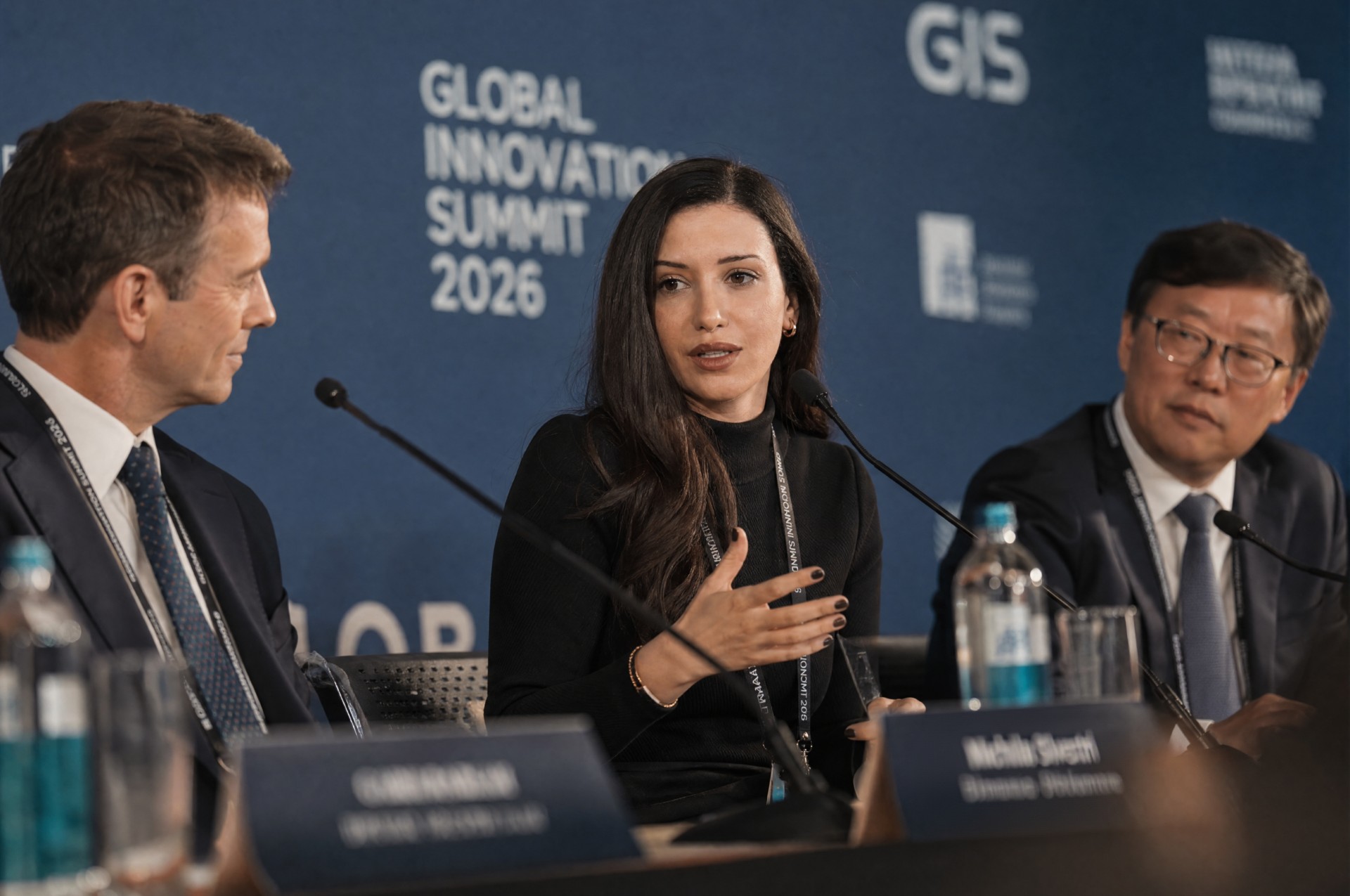
Artificial intelligence is no longer merely knocking at the door of financial markets. It has already entered the trading floor. What was until recently an auxiliary technology used to automate repetitive tasks is now becoming an operator capable of analyzing, deciding and executing in real time, raising a fundamental question: who will control the future of investing, humans or algorithms?
Among the most articulate voices in the industry on this subject is Michela Silvestri, Institutional Business Development Manager at Binance, the world’s largest cryptocurrency exchange by trading volume. In a wide-ranging interview with the international press, Silvestri explained why she believes we are only at the beginning of a transformation that will completely redefine the relationship between investors and financial markets, and how Binance is preparing for this new reality.
Asked what she means by her assertion that we are witnessing one of the biggest redistributions of opportunity in modern history, Silvestri responded: “For decades, wealth creation followed a fairly predictable formula. You needed access to the right education, the right institutions, the right networks, and often significant capital to participate in sophisticated financial opportunities. What I am seeing today is fundamentally different.”
“Every week I speak with entrepreneurs, investors and builders from around the world who are accessing opportunities that simply were not available to them a few years ago. Not because they suddenly joined elite circles, but because technology has dramatically changed the rules of access. Digital assets started this transformation by making global financial infrastructure accessible to anyone with an internet connection. Now artificial intelligence is accelerating that shift at an unprecedented pace.”
Asked why she considers AI such a significant development for financial markets, beyond being a mere productivity tool, Silvestri explained: “Because we are moving beyond AI as an assistant and entering the era of AI as an operator. Historically, sophisticated market research required teams of analysts, expensive data terminals and institutional-grade infrastructure. Portfolio management required countless hours of monitoring markets, evaluating opportunities and executing strategies.”
“An AI agent can analyze market conditions, monitor hundreds of assets simultaneously, evaluate trading opportunities, conduct research, execute predefined strategies, rebalance portfolios and continuously optimize decision-making based on changing market conditions. In many ways, we are seeing the early stages of a technological shift that could eventually give individual users access to capabilities that were previously available only to professional trading desks and large financial institutions. That is an extraordinary change.”
On how Binance is approaching this evolution, Silvestri said: “One of the areas I have been particularly excited to contribute to is how we make sophisticated infrastructure accessible through AI. We recently launched Binance AI Pro, an AI-powered trading assistant designed to simplify how users interact with financial markets.”
“Users can now leverage AI-powered interfaces to conduct market research, analyze opportunities, automate parts of their trading process, execute strategies and interact with our exchange’s trading infrastructure in a much more intuitive way. What excites me most is that this is only the beginning. Across the industry, we are seeing exchanges invest heavily in AI-powered financial copilots, intelligent execution systems, automated research capabilities and agent-driven workflows. The direction is very clear.”
On whether AI agents will eventually manage portfolios on behalf of users, Silvestri responded: “I believe AI agents will become increasingly involved in portfolio management, research and execution workflows. Today, many users already rely on AI to accelerate research and improve decision-making. The next phase is where AI agents become capable of continuously monitoring markets, identifying opportunities, generating portfolio insights and executing predefined actions within established risk parameters.”
“Of course, human oversight will remain essential, particularly as financial markets involve risk management, governance and accountability. But if you zoom out, the trajectory is clear. We are moving from a world where humans manually execute every action to one where humans increasingly supervise intelligent systems that can operate at a scale and speed that simply was not possible before.”
Asked what role companies like Binance should play in this transition, Silvestri emphasized: “I believe our responsibility goes beyond building products. Our responsibility is to continue democratizing access. Technology only creates impact when it becomes accessible. If advanced AI capabilities remain limited to hedge funds, large institutions or a small group of sophisticated market participants, then we have not really changed the system. The goal should be to make powerful financial infrastructure available to more people.”
Looking ahead five years, Silvestri concluded: “I do not think the biggest change will be digital assets or AI independently. I think the biggest change will be the combination of both. Digital assets created open financial infrastructure. AI is making that infrastructure easier to navigate and operate. When you combine borderless financial networks with intelligent agents capable of conducting research, managing workflows and executing decisions, you create a completely new model for participation.”
“The result is a world where access is no longer determined by geography, institutional affiliation or proximity to financial centers. We are moving toward a future where financial leverage, information and opportunity become increasingly accessible to anyone with an internet connection. And I believe we are still in the very early stages of that transformation.”
The vision described by Michela Silvestri reflects a trend that extends well beyond the boundaries of any single company. As more exchanges, brokers and investment platforms integrate AI agents into their infrastructure, the distance between the individual investor and the billion-dollar financial institution shrinks with every passing month. Tools that five years ago required subscriptions costing tens of thousands of dollars per year are beginning to become accessible to anyone with a phone and an internet connection.
The question that remains is no longer whether artificial intelligence will transform financial markets, but how quickly it will happen and who will be prepared. In an industry where speed and access to information have always been the most valuable currencies, the democratization of these advantages through AI could be, as Silvestri puts it, the most important redistribution of opportunity of our generation.