The metal that turns fire into flavor: on copper, tradition and skilled hands
Copper remains the central material in traditional distillation, botanical extraction and professional kitchens. A journey through the world of tuica stills, botanical distillers and copper cookware, where fire, steam and craftsmanship converge.
Copper needs no introduction. You recognize it by its color, by the weight you feel in your palm, by the way it catches the light in a workshop or a kitchen. It is the first metal humanity ever worked, long before iron or steel, and probably the only one that has never fallen out of use. The world around it has changed, but copper has stayed where it has always been: next to the fire.
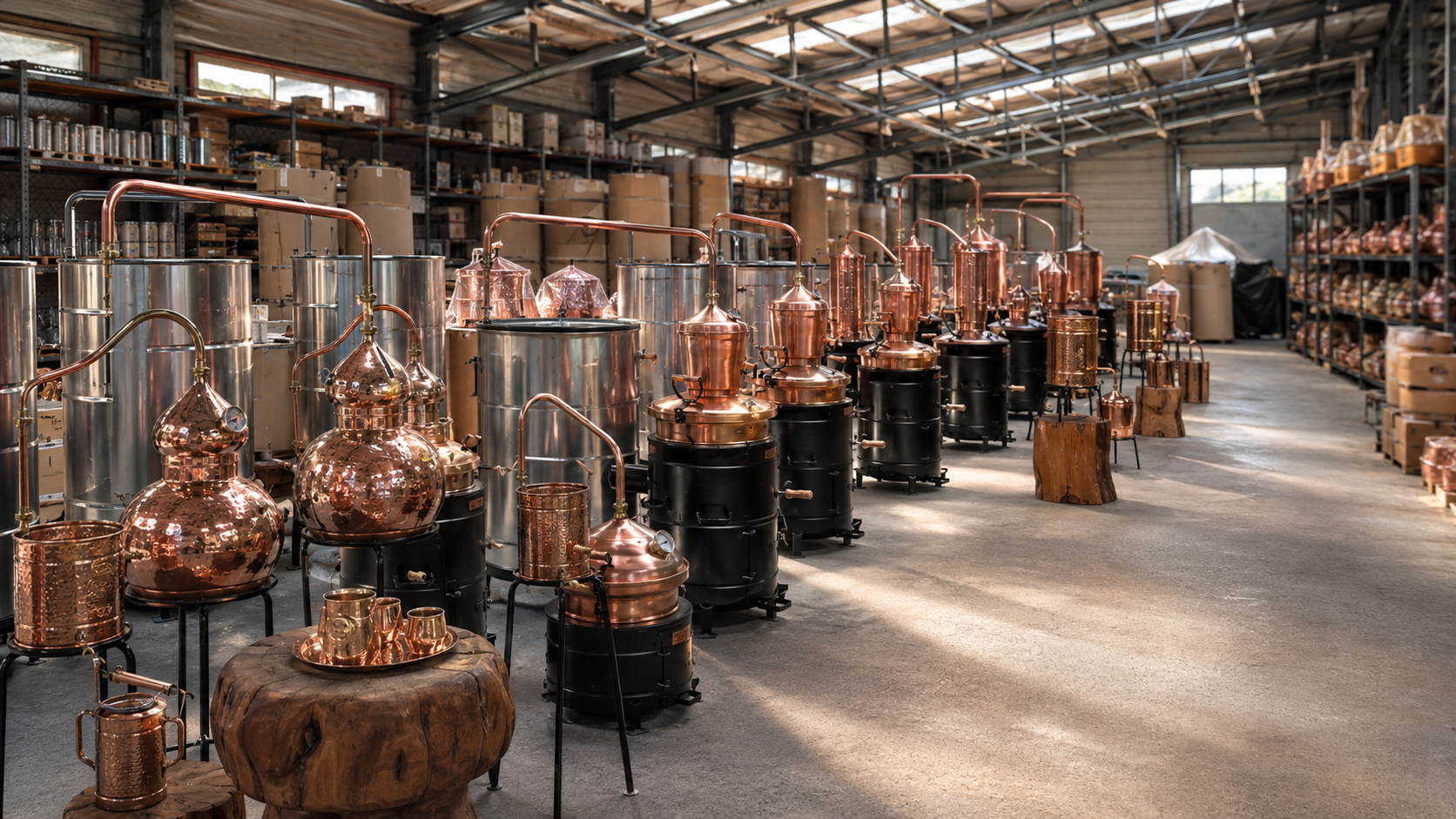
There is a place where this relationship between copper and fire takes three distinct forms. At FabricadeTuica.ro, copper appears in stills for tuica and palinca, in distillers for aromatic plants, and in cookware for professional and home kitchens. Three seemingly different categories, bound by the same principle: copper manages heat better than any other accessible material. It does not trap it, waste it, or distribute it erratically. It listens.
In Romanian households, the tuica still is not merely an object. It is an event. In autumn, when plums, apples or pears reach fermentation, the still comes out of storage, is washed, inspected and assembled. People gather around it, stories are told, patience is exercised. But beneath the ritual lies a technical process. The fermented mash is heated gradually. Alcohol vapors rise, travel through pipes and reach the condenser, where cold water transforms them back into liquid. What flows out at the end is not just alcohol. It is the expression of the raw material, passed through fire and condensed with patience.
Copper's thermal conductivity is the second highest of all metals, surpassed only by silver. In practice, this means fire reaches the mash quickly and evenly, and when the distiller reduces the flame, the still responds immediately. There is no inertia, no surprises. Fire proposes, copper executes, the human decides. The range of stills covers the full spectrum, from Hobby models at 25 liters to the Exclusive series at 350 liters, with tipping variants, electric stirrers and classic alembics.
No matter how good the equipment, the moment of truth belongs to the human. In distillation, the liquid does not flow uniformly from start to finish. The first fractions, called heads, contain volatile compounds that the experienced distiller recognizes by smell and separates. Next comes the heart, the core of the distillate, the part that reaches the bottle. Toward the end come the tails, weaker and heavier. Nobody learns this separation from a manual. It is learned by doing, by making mistakes, by smelling, by tasting. A grandfather showed his grandson when to switch the vessel. Modern stills do not erase this tradition. They make it more controllable.
The same passion for copper opens a second world, more fragrant and more delicate. Column distillers are designed for extracting hydrolats, floral waters and essential oils from aromatic plants: lavender, roses, mint, rosemary, chamomile, thyme. The principle differs from tuica. The plants are not boiled. They are placed on a grate above the water vessel, and steam rises through the plant material, extracting aromatic compounds and carrying them to the condenser. It is a gentler, more patient, more fragrant distillation.
Copper does not stop at distillation. It steps down from the workshop shelf and enters the kitchen, onto the stove, the table, the serving area. Pots, cauldrons, pans, skillets, trays, kettles and utensils, all copper, all with the same fundamental property: they respond to fire instantly. In a professional kitchen, a copper pan is not nostalgia. It is an instrument of precision. The sauce responds to the flame. Sugar caramelizes evenly. And visually, a massive copper cauldron on a restaurant table creates an experience that transcends taste and reaches the eye.
Copper asks for something in return. It asks to be cleaned after every use, with lemon, vinegar or baking soda. It asks to be rinsed with clean water and dried by hand. But in return it offers something rare: longevity. A properly maintained copper still functions for decades. It develops patina, changes its hue, accumulates story. It does not become morally obsolete. It matures. This is the meaning of the expression living material: a metal that reacts to air, humidity, heat, and the hand that uses it.
Copper does not promise miracles. It will not turn a weak mash into good tuica. It will not make a mediocre cook into a chef. It will not extract essential oil from a plant that has no fragrance. But to the one who knows what they are doing, it offers the most honest working partner possible: a metal that does not lie, does not rush, and does not tire. And that, after ten thousand years, is still irreplaceable.
The full range of tuica stills, botanical distillers and copper cookware can be explored at FabricadeTuica.ro.
Loading article...
The metal that turns fire into flavor: on copper, tradition and skilled hands
culture | FabricadeTuica.ro |
Copper remains the central material in traditional distillation, botanical extraction and professional kitchens. A journey through the world of tuica stills, botanical distillers and copper cookware, where fire, steam and craftsmanship converge.
Copper needs no introduction. You recognize it by its color, by the weight you feel in your palm, by the way it catches the light in a workshop or a kitchen. It is the first metal humanity ever worked, long before iron or steel, and probably the only one that has never fallen out of use. The world around it has changed, but copper has stayed where it has always been: next to the fire.
There is a place where this relationship between copper and fire takes three distinct forms. At FabricadeTuica.ro, copper appears in stills for tuica and palinca, in distillers for aromatic plants, and in cookware for professional and home kitchens. Three seemingly different categories, bound by the same principle: copper manages heat better than any other accessible material. It does not trap it, waste it, or distribute it erratically. It listens.
In Romanian households, the tuica still is not merely an object. It is an event. In autumn, when plums, apples or pears reach fermentation, the still comes out of storage, is washed, inspected and assembled. People gather around it, stories are told, patience is exercised. But beneath the ritual lies a technical process. The fermented mash is heated gradually. Alcohol vapors rise, travel through pipes and reach the condenser, where cold water transforms them back into liquid. What flows out at the end is not just alcohol. It is the expression of the raw material, passed through fire and condensed with patience.
Copper's thermal conductivity is the second highest of all metals, surpassed only by silver. In practice, this means fire reaches the mash quickly and evenly, and when the distiller reduces the flame, the still responds immediately. There is no inertia, no surprises. Fire proposes, copper executes, the human decides. The range of stills covers the full spectrum, from Hobby models at 25 liters to the Exclusive series at 350 liters, with tipping variants, electric stirrers and classic alembics.
No matter how good the equipment, the moment of truth belongs to the human. In distillation, the liquid does not flow uniformly from start to finish. The first fractions, called heads, contain volatile compounds that the experienced distiller recognizes by smell and separates. Next comes the heart, the core of the distillate, the part that reaches the bottle. Toward the end come the tails, weaker and heavier. Nobody learns this separation from a manual. It is learned by doing, by making mistakes, by smelling, by tasting. A grandfather showed his grandson when to switch the vessel. Modern stills do not erase this tradition. They make it more controllable.
The same passion for copper opens a second world, more fragrant and more delicate. Column distillers are designed for extracting hydrolats, floral waters and essential oils from aromatic plants: lavender, roses, mint, rosemary, chamomile, thyme. The principle differs from tuica. The plants are not boiled. They are placed on a grate above the water vessel, and steam rises through the plant material, extracting aromatic compounds and carrying them to the condenser. It is a gentler, more patient, more fragrant distillation.
Copper does not stop at distillation. It steps down from the workshop shelf and enters the kitchen, onto the stove, the table, the serving area. Pots, cauldrons, pans, skillets, trays, kettles and utensils, all copper, all with the same fundamental property: they respond to fire instantly. In a professional kitchen, a copper pan is not nostalgia. It is an instrument of precision. The sauce responds to the flame. Sugar caramelizes evenly. And visually, a massive copper cauldron on a restaurant table creates an experience that transcends taste and reaches the eye.
Copper asks for something in return. It asks to be cleaned after every use, with lemon, vinegar or baking soda. It asks to be rinsed with clean water and dried by hand. But in return it offers something rare: longevity. A properly maintained copper still functions for decades. It develops patina, changes its hue, accumulates story. It does not become morally obsolete. It matures. This is the meaning of the expression living material: a metal that reacts to air, humidity, heat, and the hand that uses it.
Copper does not promise miracles. It will not turn a weak mash into good tuica. It will not make a mediocre cook into a chef. It will not extract essential oil from a plant that has no fragrance. But to the one who knows what they are doing, it offers the most honest working partner possible: a metal that does not lie, does not rush, and does not tire. And that, after ten thousand years, is still irreplaceable.
The full range of tuica stills, botanical distillers and copper cookware can be explored at FabricadeTuica.ro.