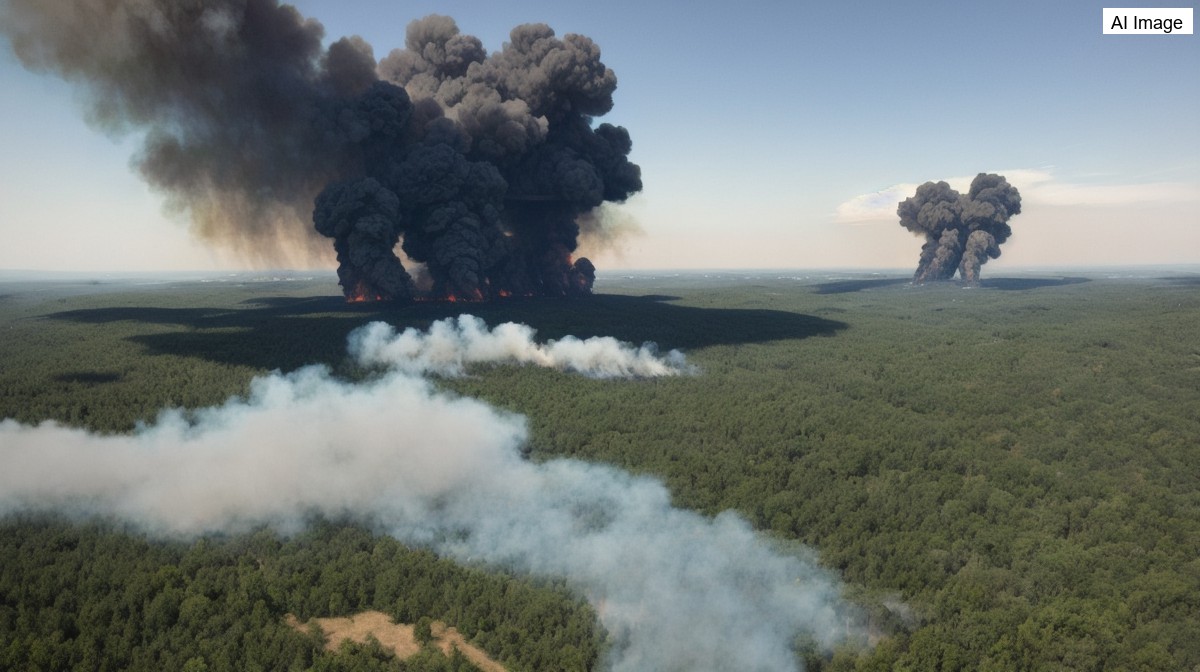
A high-altitude NASA spy plane was tracked this month flying over British Columbia, and its unusual mission has drawn attention to one of the most extreme byproducts of Canada's wildfires. The aircraft was there to study fire clouds, the self-perpetuating thunderstorms that the province's massive blazes are now generating. For six hours straight, the plane was observed flying back and forth over Western Canada.
The aircraft itself has a striking history. It is a NASA ER-2, a modified Lockheed U-2 nicknamed the Dragon Lady, the type of plane the U.S. military once used in the pre-satellite era to study the ground from extraordinary heights. Flying at around 60,000 feet, the ER-2 sits safely in the stratosphere and looks straight down into the core of a storm, measuring the exact height, temperature and thickness of the smoke plume in real time.
The reason for the flights is the fire cloud, known scientifically as pyrocumulonimbus, or Cumulonimbus flammagenitus. It was officially added to the International Cloud Atlas in 2017, and scientists have been trying to understand it ever since. These clouds are not ordinary weather; they are storms born directly out of the flames of a large wildfire.
The mechanism behind them is violent. When a wildfire grows big and hot enough in a short amount of time, it triggers giant, violent updrafts. Superheated air and moisture act like a vacuum, pulling winds and oxygen into the base of the fire and giving it more fuel, while punching smoke straight up into the sky. The result is a literal thunderstorm that generates its own downbursts, erratic lightning strikes and even fire tornadoes.
What makes these storms a concern well beyond the fire line is how high they reach. Scientists once thought only large volcanic eruptions or nuclear blasts could force particles into the stratosphere. Now researchers know that intense pyrocumulonimbus clouds can shoot plumes of black carbon and aerosols up to 16 kilometres into the lower stratosphere, where they become trapped.
The timing of the mission reflects the scale of this year's fire season. Canada has been dealing with explosive wildfires, including the Bald Range fire that erupted in size on August 7. Research shows climate change is making these fire-cloud-producing megafires occur more often, and according to the latest findings, they happen most often in Canada, which is part of why NASA sent the plane directly over the smoke.
The flight was carefully targeted. The ER-2 took off from Great Falls, Montana, and circled British Columbia's southern interior more than a dozen times, with most of the flight centred on the massive Pear Lake wildfire, which has been burning out of control for more than a month. The goal is to figure out exactly how these firestorms develop so they can be forecast, because understanding the fire monster is seen as the first step to surviving it.