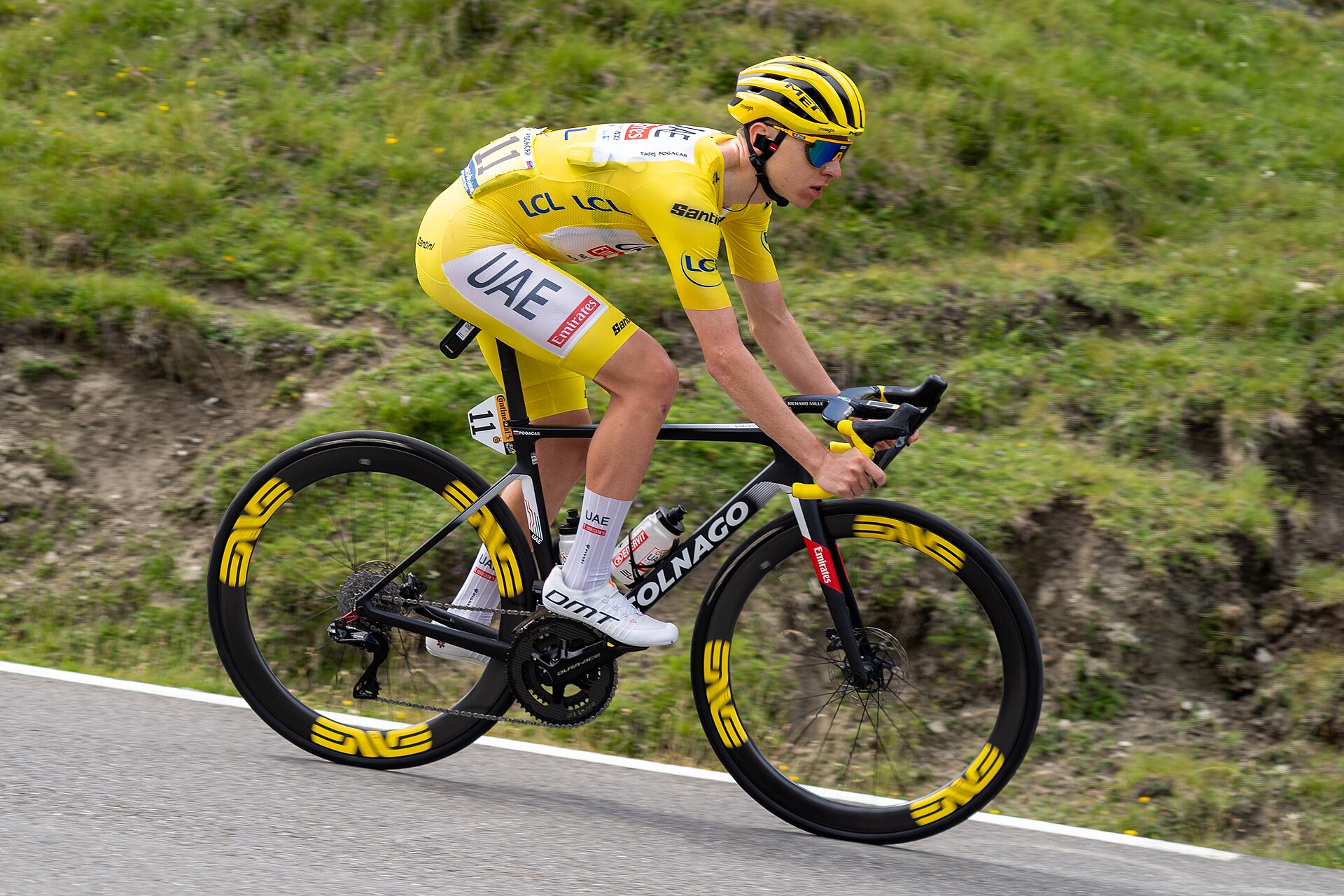
For more than a century, the Tour de France has been the hardest test in professional sport, a three-week war of attrition across the mountains of Europe that breaks most of the men who attempt it. Only a tiny handful have ever truly mastered it. In the summer of 2026, on the streets of Paris, Tadej Pogacar joined that most exclusive club, winning his fifth Tour de France and drawing level with the greatest names the sport has ever produced. For anyone who follows cycling, it felt less like a victory and more like a coronation.
The Slovenian did not merely win. He dismantled the race, turned its most feared climbs into personal showcases, and left his rivals racing for the scraps of the podium. To understand why this was so remarkable, you have to look past the yellow jersey and into the numbers, because they describe a level of dominance that even the sport's historians are struggling to place.
Pogacar's triumph in the 113th edition of the Tour made him only the fifth rider ever to win the race five times. He now shares that record with a quartet of legends: the Belgian Eddy Merckx, the Spaniard Miguel Indurain, and the Frenchmen Bernard Hinault and Jacques Anquetil. These are not just former champions, they are the founding gods of the sport, names spoken with reverence in every cycling nation. To sit alongside them before the age at which many riders even peak is an achievement that borders on the absurd.
The manner of the win underlined his superiority. He crossed the finish line in Paris a full 6 minutes and 26 seconds ahead of the second-placed Belgian Remco Evenepoel, with the young Mexican Isaac del Toro completing the podium. In a sport where the biggest races are often decided by mere seconds after ninety hours of riding, a winning margin of more than six minutes is a statement of near-total control.
If one moment captured his dominance, it was his ride up the Col du Tourmalet, one of the most storied climbs in cycling. Pogacar attacked from distance and set a new fastest time to the summit of 43 minutes and 12 seconds, obliterating the previous record of 45 minutes and 32 seconds, a mark he himself had set alongside his great rival back in 2023. To beat anyone's record on such a climb is special. To beat your own by well over two minutes is the kind of leap that makes people ask uncomfortable questions about the limits of human performance.
Across the three weeks he claimed five stage victories, a haul that would make a career for most riders and which he now collects almost as a matter of routine. His signature is the long-range attack, going clear not in the final few hundred metres like a sprinter, but kilometres from the top of a mountain, a tactic so bold it was once considered reckless and which he has turned into an art form.
No champion is made in a vacuum, and Pogacar's legend has been forged against a worthy foe. The Dane Jonas Vingegaard beat him to the title in both 2022 and 2023, halting his early charge and proving he was human after all. Their duels became the defining rivalry of modern cycling, two very different champions trading blows on the highest peaks. In 2026, though, the story turned cruel for Vingegaard, who crashed out of the race on stage 15, ending a remarkable run of podium finishes and removing the one man capable of pushing Pogacar to his limit.
What separates Pogacar from many past Tour winners is that he refuses to specialise. Where most modern champions build their entire season around a single three-week race, he wins across every kind of terrain, adding the sport's brutal one-day Monuments, a world championship title and even the Giro d'Italia to his palmares. It is a breadth of ambition that recalls Eddy Merckx himself, the man nicknamed the Cannibal for his insatiable appetite for victory. Increasingly, that same word is being attached to Pogacar, and it fits.
Inevitably, the debate has begun in earnest: is Tadej Pogacar the greatest cyclist who ever lived? It is a difficult and perhaps impossible comparison across eras of different bikes, science and racing styles. Merckx still holds a mountain of records that may never fall, and greatness in cycling is measured in far more than Tour victories. Yet the sheer rate at which Pogacar wins, and the variety of races he conquers, means the question is now serious rather than fanciful. He is still in his twenties, and the record books are within reach.
It would be wrong to romanticise the Tour without acknowledging its dangers. Vingegaard's crash was a reminder that these riders descend mountain roads at terrifying speeds, and that a single mistake or a wet corner can end a season in an instant. Dominance also invites scrutiny, and cycling, scarred by its past, watches its superstars more closely than almost any other sport. Pogacar races in the shadow of that history, and every extraordinary performance is met with both awe and questions, a burden that comes with being this far ahead of everyone else.
The scale of Pogacar's 2026 Tour is captured in a few figures:
The most daunting thought for the rest of the peloton is that Tadej Pogacar is almost certainly not finished. A sixth Tour, which would take him clear of every rider in history, is no longer a fantasy but a genuine target, and there are few signs of anyone able to stop him. Sport is at its most compelling when it witnesses greatness in real time, when a fan can honestly say they watched one of the very best there has ever been. In 2026, cycling had exactly that. The Cannibal has been reborn, and the sport is racing to keep up with him.